How global warming, typhoons, and airtight homes are silently fueling Okinawa’s hidden mold crisis
2025/12/15
1. Climate Change and the Rising Risk of Mold Growth
1.1 How Rising Temperature and Humidity Fuel Mold Proliferation
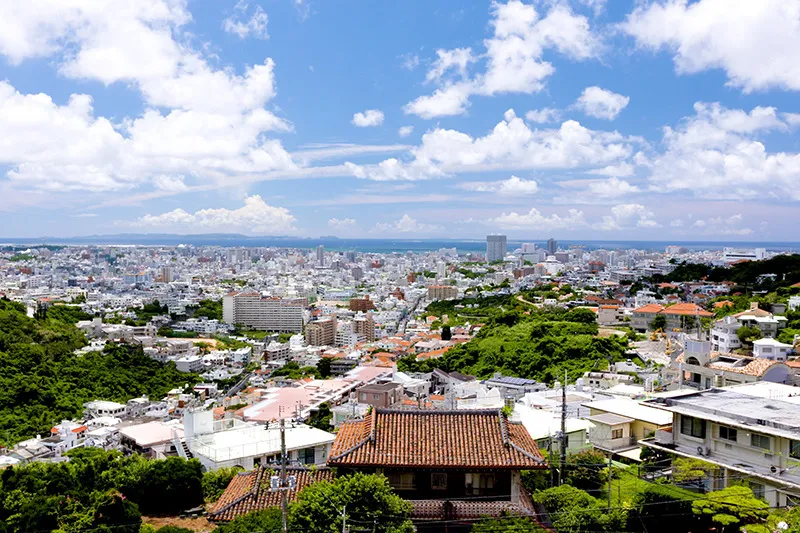
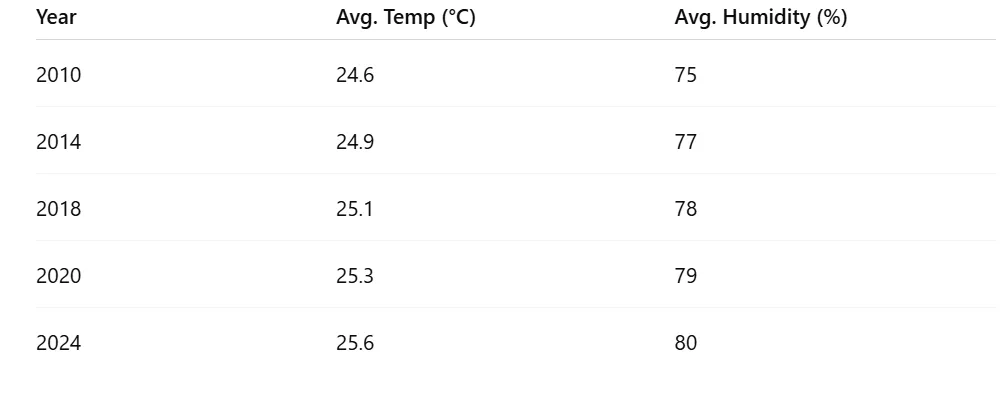
Over the past decade, Okinawa’s climate has changed dramatically. According to data from the Japan Meteorological Agency, average annual temperatures in Naha now exceed 25°C, while average summer humidity remains around 80%—ideal conditions for mold growth.
Most molds thrive between 25°C and 35°C with humidity above 70%, meaning that Okinawa’s environment provides near-perfect conditions for mold almost year-round.
One concerning trend is the increase in nighttime temperatures, which previously helped reduce indoor humidity overnight. Now, persistent warmth keeps condensation on surfaces longer, allowing mold to establish colonies behind walls, under floors, and in other unseen areas.
Additionally, heavier rainfall and prolonged post-typhoon humidity mean that moisture remains trapped inside buildings for longer, increasing mold outbreaks in air conditioners, ceilings, and closets.
2. Modern Housing and Lifestyle Changes Increasing Hidden Mold Risks
2.1 The Hidden Danger of Condensation in Airtight, Insulated Homes
In response to energy-saving trends, Okinawa has seen a rapid rise in airtight and highly insulated homes designed for better cooling efficiency. While these structures reduce power consumption, they also trap humidity inside, creating perfect conditions for internal condensation and mold.
When outside air cannot circulate, moisture from cooking, bathing, and laundry accumulates indoors. This often results in interstitial condensation—moisture forming inside walls and insulation layers—especially where temperature differences between interior air and walls occur.
Modern homes also have fewer natural airflow gaps than older designs, so stagnant air builds up in wall cavities and under floors, creating long-term dampness.
🏠 Illustration Concept: “Moisture Trapping Points in Airtight Homes”
A cross-section diagram showing:
Indoor humidity sources (bathroom, kitchen)
Condensation occurring within insulation layers
Mold growth behind the walls and ceiling
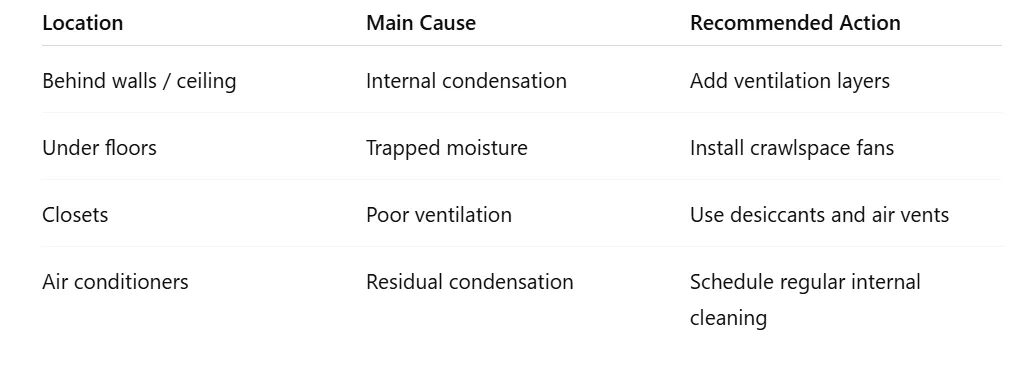
Modern housing may look clean, but beneath the surface, unseen humidity accumulates. In Okinawa’s humid climate, even small areas of trapped moisture can trigger serious mold contamination within one to two years.
3. Typhoons, Flooding, and Secondary Mold Damage
3.1 How Flooding, Power Outages, and Prolonged Dampness Create Secondary Mold Disasters
Recent years have brought stronger, slower-moving typhoons that linger over Okinawa for one or two days, bringing intense rainfall and humidity.
After these storms, secondary damage from flooding and leaks becomes a major mold hazard. Once moisture seeps into walls or under floors, it can take weeks to dry, during which mold spores multiply rapidly inside wood and insulation.
When power outages occur, dehumidifiers and air conditioners stop working, allowing indoor humidity to surge. Within 48 hours, black and white molds begin to colonize walls, ceilings, and even furniture.
Cracks in exterior walls or aging sealants can also allow hidden moisture infiltration, leading to invisible mold layers that remain long after visible water damage has dried.
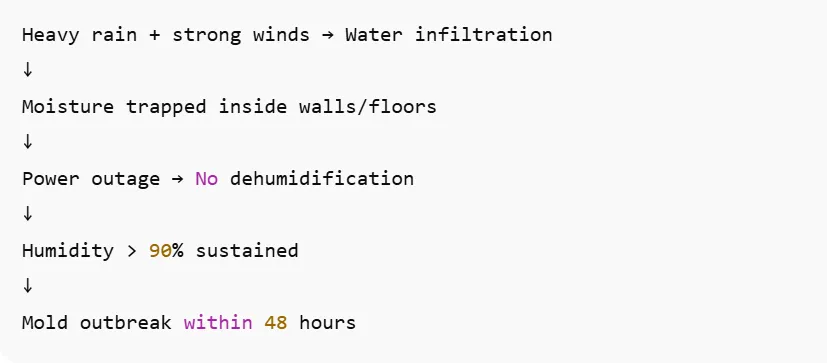
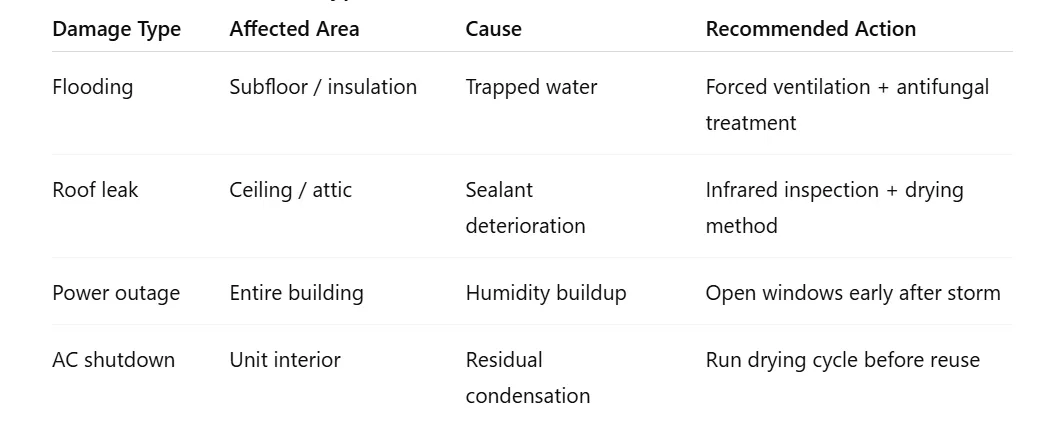
According to surveys by the Mold Busters Group, around 70% of inspected homes within three days after typhoons show measurable mold contamination. Rapid drying, moisture monitoring, and professional treatment are essential to stop secondary mold explosions.
4. Mold Risks in Tourism, Food, and Hospitality Businesses
4.1 The Combined Impact of Sea Breeze, Humidity, and Air Conditioning
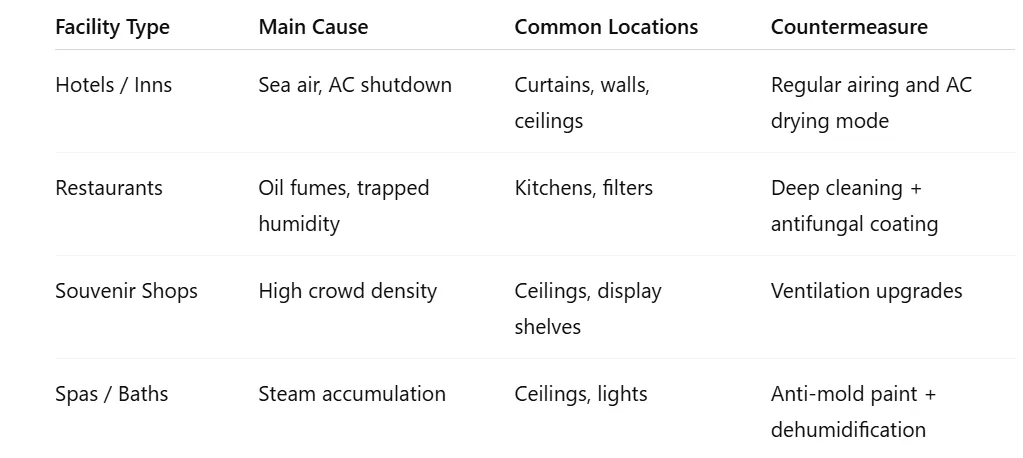
In Okinawa’s coastal hospitality industry, mold problems are aggravated by salt-laden sea air combined with persistent humidity.
While salt itself doesn’t feed mold, it corrodes surfaces and creates microscopic cracks where mold spores easily settle and grow. In restaurants, oil vapors and organic residues provide nutrients for mold inside ducts, filters, and refrigeration units.
Hotels often face a paradox: unused rooms grow mold faster than occupied ones, as air conditioning is turned off between guests, allowing humidity to rise. During typhoon or rainy seasons, clogged dehumidifier drains and condensation buildup worsen air quality throughout facilities.
💡 Diagram Concept: “How Sea Breeze and Humidity Spread Mold Indoors”
An airflow illustration showing how salt air corrodes metal, traps spores, and circulates through air conditioning ducts.
New preventive measures for these businesses include:
Full disassembly and internal cleaning of AC systems
Anti-corrosion coating on exteriors and metal components
Continuous humidity monitoring
Scheduled “rest-day ventilation routines”
The MIST® sterilization method used by Mold Busters Okinawa has proven especially effective for these mixed issues—removing microbes, odors, and salt residue simultaneously.
5. The Future of Mold Prevention in Okinawa
5.1 Environmental and Technical Measures for Homes, Businesses, and Public Facilities
Mold problems in Okinawa now extend beyond cleaning—they require environmental engineering solutions. As climate conditions increasingly favor mold growth, a comprehensive approach across homes, workplaces, and public buildings is essential.
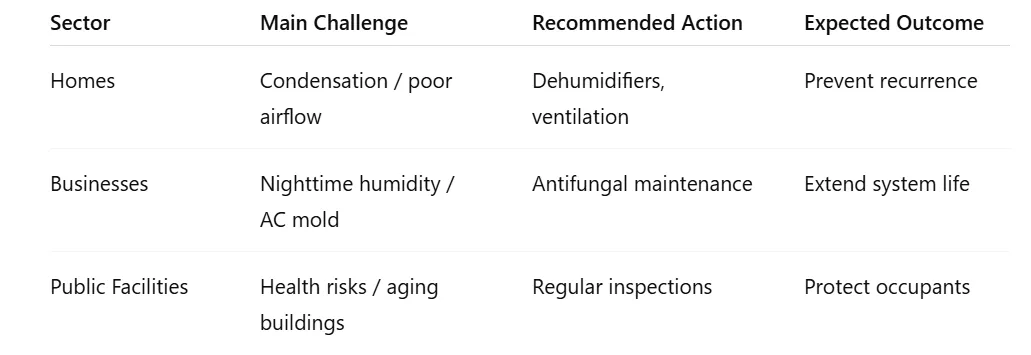
🏠 Homes
Focus on the “3 Principles of Mold Prevention”: Ventilation, Dehumidification, and Cleanliness.
Install underfloor ventilation fans, maintain air circulation, and use humidity sensors in storage areas.
Compact desiccant dehumidifiers and retrofit ventilation systems now make continuous prevention easier, forming part of what Mold Busters Okinawa calls a “Sustainable Mold Control Design.”
🏢 Businesses
For offices and restaurants, equipment hygiene is critical. Timed night ventilation, antifungal coatings, and scheduled MIST® treatments help prevent microbial buildup and extend equipment life.
Regular airborne mold testing ensures healthy air for employees and customers alike.
🏫 Public Facilities
Schools, hospitals, and government buildings face greater responsibility to maintain hygienic environments.
Key measures include:
Anti-mold building materials during construction
Periodic air quality inspections
Third-party microbial testing through certified organizations
The Mold Busters Group collaborates with the Microbial Control Association to provide scientifically validated testing and reporting systems.
🌈 Conclusion
Okinawa’s mold issue has entered a new era.
The focus must shift from “cleaning after mold appears” to “designing environments where mold cannot thrive.”
With climate change reshaping local conditions, mold prevention now demands scientific analysis, continuous monitoring, and professional intervention.
Through the MIST® method, environmental inspections, and laboratory testing, Mold Busters Okinawa is leading the way toward a future of sustainable, region-specific mold management.
It’s time for homeowners, businesses, and government agencies to work together in building a cleaner, healthier, and mold-resilient Okinawa.
----------------------------------------------------------------------
カビバスターズ沖縄
沖縄県国頭郡金武町伊芸1996-13
電話番号 : 080-3977-9591
----------------------------------------------------------------------