Cultural and Environmental Perspectives on How People Coexist with Mold Around the World
2025/11/17

目次
1. Awareness of Mold in Japan and Its Cultural Background
1.1. Cleanliness and the “Mold = Evil” Mindset
In Japan, mold is viewed as a symbol of uncleanliness—something that must never appear in a well-kept home. The idea that “mold equals failure in hygiene” runs deep, rooted in the country’s humid climate and long-standing cultural emphasis on cleanliness.
With high humidity year-round and the rainy season amplifying indoor moisture, Japanese households have long practiced “mold prevention habits” such as airing rooms daily, drying bedding in sunlight, and cleaning thoroughly before the rainy season. These traditions are not just chores—they are cultural rituals shaped by centuries of living in a damp climate.
Japanese society also places immense value on appearance and cleanliness. A moldy wall or musty smell can instantly harm a restaurant’s or hotel’s reputation, as cleanliness is tied directly to trust and social credibility. Thus, mold is not viewed as a natural occurrence but as something that must be eliminated.
Education and media reinforce this notion. Children learn early that “mold causes rot and illness,” cultivating a fear of contamination. Combined with the pressure of social media exposure—where a single photo of mold can spark criticism—this has created a culture obsessed with zero-mold environments.
Consequently, Japan has developed one of the most advanced markets for mold prevention products: dehumidifiers, anti-mold coatings, and antibacterial wallpapers are common. In short, for many Japanese people, fighting mold is not just maintenance—it’s a moral duty.
2. Perception of Mold Overseas
2.1. Mold as a Natural Part of Life
In contrast, many countries—especially in Europe and North America—view mold through a very different lens. Rather than being seen as a failure, mold is often regarded as a natural phenomenon that comes with life in a humid world.
In Europe, where many buildings are made of stone or brick and have stood for centuries, minor mold or moss growth is not unusual. People tend to see it as “part of the building’s history” or even “character.” Particularly in the UK and France, a little mold is accepted as a trace of time rather than a sign of neglect.
In the United States, where many regions are dry, awareness of mold is less intense. People respond only when it becomes a clear health or structural issue—a reactive approach. In contrast, Japan’s approach is proactive, focusing on preventing mold before it even appears.
Food culture also illustrates this contrast. In Europe, mold is celebrated in blue cheese and wine aging—proof of how it can enhance flavor and depth. This reflects a cultural idea of coexistence with nature. In Japan, fermentation exists too (miso, soy sauce, sake), but through tightly controlled molds such as koji. Thus, Japan “controls nature,” while Europe “coexists with it.”
Even in schools, Western students learn that mold is a “decomposer” essential to the ecosystem, not just a villain. As a result, when people find a little mold at home, they tend to respond calmly—fixing ventilation or cleaning gently—without panic or stigma.
In summary, while Japan treats mold as an enemy, many Western countries see it as an element of nature to be managed, not eradicated.
3. How Different Perceptions Lead to Different Actions
3.1. Climate, Architecture, and Habits Create the Gap
The gap in awareness directly affects how people design homes, clean, and respond to moisture.
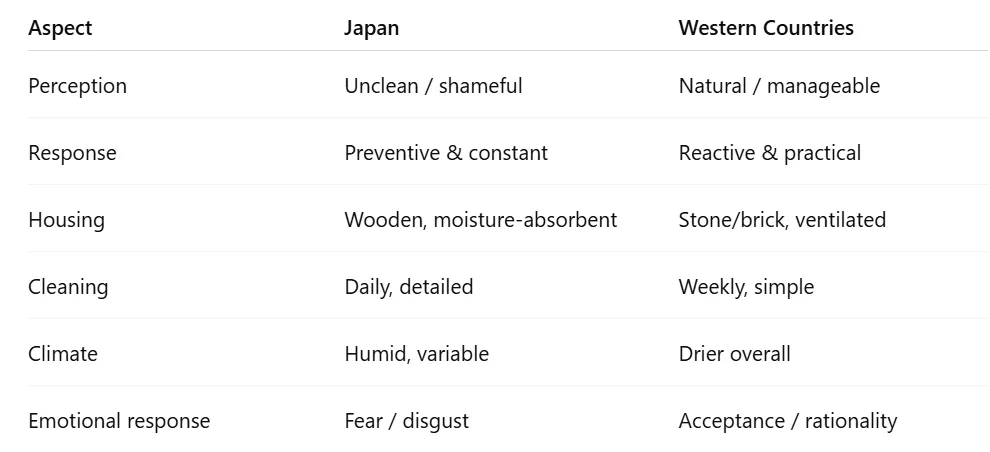
Japan’s wooden homes, tatami mats, and paper-based walls readily absorb moisture. During the humid summer, indoor humidity can exceed 80%, creating perfect conditions for mold. Hence, daily routines such as airing rooms, wiping surfaces, and using dehumidifiers are second nature.
In contrast, European and American homes are built differently. Brick or stone walls breathe naturally and allow moisture to escape. Roofs, basements, and attics are designed with strong ventilation paths to prevent condensation. The focus is on preventing mold by design, not fighting it after it appears.
Lifestyle also differs. Japanese families practice small, frequent cleaning—wiping bathrooms after every use, regularly opening closets, and constantly checking for humidity. Western families tend to do weekly or seasonal cleanings, focusing less on daily moisture management.
Climate plays a major role: Japan’s high humidity and seasonal rain make mold prevention essential. Many Western regions are drier, making mold less of a daily concern.
This leads to a psychological divide: Japanese people feel shame or anxiety when mold appears, while Westerners see it as manageable. Even in property management, Japan often faces tenant–landlord disputes over mold, whereas Western systems treat it as a maintenance issue, not a moral failure.
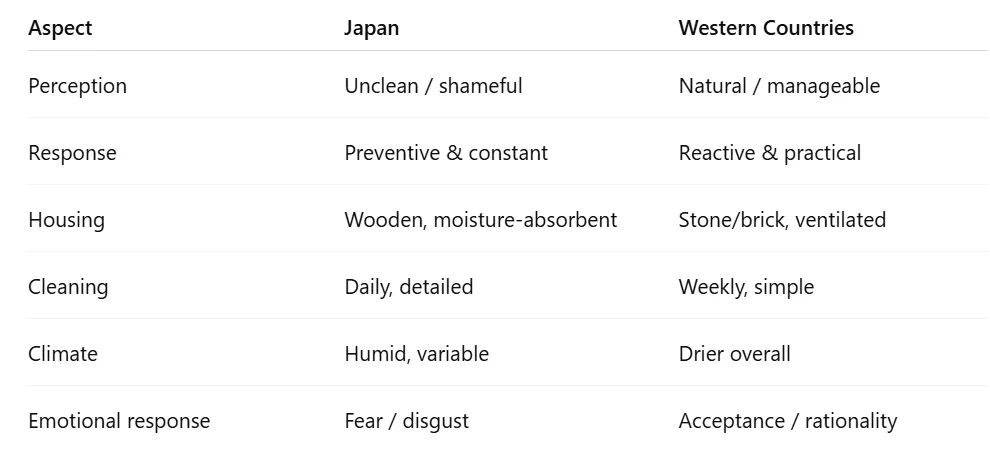
Ultimately, these differences show that mold management is not just about science—it’s about how people live with their environment.
4. From Cultural Contrast to Global Perspective
4.1. The Key: Balancing Science and Culture
The difference between Japan and other countries highlights the need for a new mindset—one that balances cultural values with scientific understanding.
Japan’s obsession with eliminating mold has created a highly hygienic society, but also one that sometimes overuses chemicals or feels psychological stress from minor mold. Conversely, the Western “natural tolerance” approach avoids panic but can overlook hidden risks.
A truly effective mold strategy lies in the middle: rational prevention based on science, without cultural fear or neglect.
In Japan, smart homes and IoT humidity sensors are emerging, allowing real-time monitoring of temperature and moisture. Eco-friendly solutions such as natural antibacterial materials and microbial balance control are gaining traction. These represent a shift from “killing mold” to “managing the environment.”
At the same time, education must evolve. Instead of teaching “mold is bad,” schools and media should explain its ecological role. By understanding mold as part of the natural cycle, people can act calmly and intelligently when dealing with it.
Architecturally, blending Japan’s craftsmanship and Western ventilation design can lead to sustainable homes that breathe—houses that balance insulation, air circulation, and humidity control.
Mold Busters Okinawa embodies this global perspective. By combining scientific testing, environmental analysis, and specialized removal methods, it provides balanced, culturally aware solutions suited to Japan’s unique climate.
In the end, mold should not be seen solely as a “problem to eliminate,” but as a natural signal reminding us to care for our environment.
When culture, science, and awareness align, we move closer to a sustainable lifestyle—one where humans and nature truly coexist.
----------------------------------------------------------------------
カビバスターズ沖縄
沖縄県国頭郡金武町伊芸1996-13
電話番号 : 080-3977-9591
----------------------------------------------------------------------