Uruma: New-home mold enquiry
2026/10/27
If you notice mold, a musty smell or an unexpected damp area in a new home in Uruma, start by recording what you can actually see and asking who will investigate it. A new building is not a reason to dismiss a concern, but a stain alone does not establish a construction defect, legal responsibility or the cause of a health problem. Keep those questions separate.
This guide helps you prepare a practical enquiry for your builder or other responsible contact. It is not a report of a particular customer case. Kabi Busters Okinawa can discuss the building-related mold enquiry within its agreed scope; this article does not promise legal representation, compensation, a free inspection or a particular repair outcome.
A 60-second guide to this article
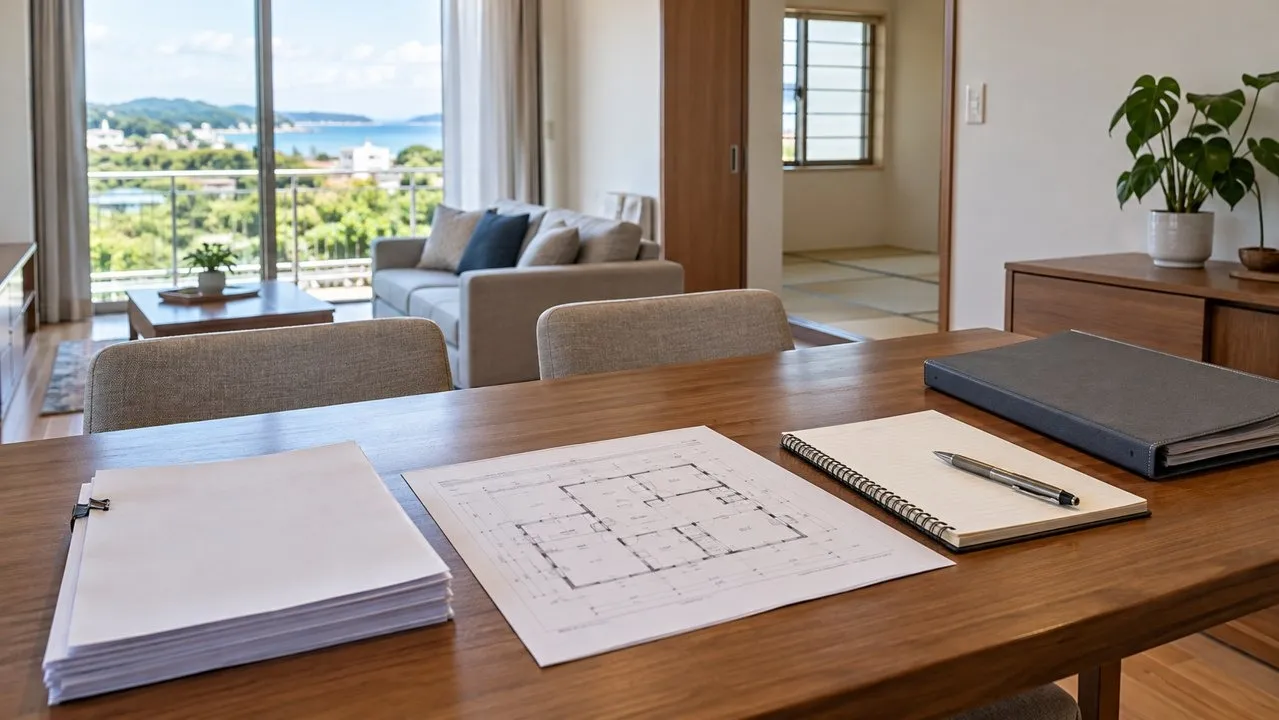
60 seconds, silent, with English captions. AI illustrative imagery; not an actual inspection or work record.
目次
1. Build a factual discovery record before making a claim
1. Discovery
Rooms, dates and photographs
2. History
Handover, occupancy and previous work
3. Limits
Keep unknown information visible
Write down the handover date, move-in date and discovery date separately. If you have not moved in, explain who has had access and what is known about the building's use during that period. Do not fill gaps with assumptions. “I did not inspect the back of this cupboard at handover” is more accurate than saying it was definitely clear at that time.
Take an overall room photograph and a closer photograph of the affected surface, if you can do so safely. Give the room a consistent name and identify the wall, window or fitting nearby. A simple floor plan with numbered positions helps a person who has never visited the home understand the photographs. Keep the original dates and retain earlier versions rather than replacing them with the latest image.
Record visible dampness, staining and odors as observations. Explain whether you noticed a change after rain, during air-conditioning use or after the home had been closed. A timing relationship is useful information, but it is not proof of the water source. Do not approach mold to smell it deliberately, move heavy furniture alone or open a wall to collect evidence.
If cleaning, drying or repairs have already taken place, note the date, area, products or work described, and what changed afterward. Do not hide an earlier intervention because you worry it will complicate the conversation. The next professional needs to know the sequence. Where there is an immediate building or electrical safety concern, contact the appropriate professional rather than delaying action solely to preserve a photograph.
Keep health information in a separate channel. A clinician can advise about symptoms and treatment; a building inspection does not diagnose a person. You do not need to attach family medical records to a construction photograph folder. If a health concern affects access or occupancy during work, ask the relevant medical and building contacts what information each needs.
2. Turn your documents into a clear builder enquiry
1. Documents
Plans and relevant correspondence
2. Enquiry
Ask a clear building question
3. Advice
Separate technical and legal roles
Collect the handover pack, relevant plans, equipment instructions, previous inspection notes and correspondence that relates to the affected area. You do not have to understand every technical term before contacting the builder. Identify the document, its date and the question it raises. Keep uncertain information clearly marked instead of editing a document to make the timeline look complete.
Ask who is handling the enquiry and how the site visit will be arranged. Useful questions include which room will be inspected, who needs to attend, what documents are wanted and when you can expect the next response. Request a written summary of agreed next steps. This creates a practical record without asking a contractor to give a medical or legal conclusion outside their role.
Separate an observation from a request. For example, describe the room and discovery date first, then ask for the relevant area to be checked and the inspection scope explained. Avoid presenting a suggested cause as a settled fact. If different contacts give different explanations, ask which locations and records support each explanation rather than trying to decide the issue from a short phrase alone.
Keep a contact log: who received the enquiry, which photographs were sent, what reply was given and what remains outstanding. If you send an update, label it as an addition with its own date. Make sure everyone is discussing the same plan and photograph numbers. Repeatedly rewriting the original message can make it harder to distinguish the first discovery from later developments.
Contractual questions and building questions may need different advice. Japan's Housing Renovation and Dispute Settlement Support Center provides housing consultation information through Sumairu Dial. Check its current service scope and eligibility directly. If you need advice about rights, liability or a dispute, seek an appropriately qualified professional. Do not assume a mold contractor is also your legal representative or can guarantee the result of negotiations.
3. Agree what the inspection will and will not establish
1. Scope
Access, methods and exclusions
2. Permission
Opening and restoration arrangements
3. Report
Findings, interpretation and limits
Before a visit, ask whether the proposal covers visible surfaces, equipment checks, measurements, sampling or opening materials. “Inspection” does not automatically mean that every wall cavity, ceiling void or concealed pipe will be examined. Discuss access restrictions, furniture, keys and the person who can approve any additional work. An area that cannot be accessed should remain recorded as uninspected.
If a measurement is proposed, ask what question it is meant to answer. The report should identify the location and relevant conditions, not just display a number. One measurement does not describe an entire house. When comparing two reports, check whether they measured the same material, position and conditions before treating different numbers as conflicting conclusions.
Sampling also needs a defined purpose. Ask where samples would be taken, what method is proposed, what the cost includes and what the result cannot establish. A sample does not, by itself, determine a person's illness or settle a contractual dispute. Do not commission an extensive test programme simply because an unfamiliar organism name sounds alarming; discuss the building decision that the result would inform.
Opening a wall or removing a material needs its own discussion. Confirm the location, purpose, protection of surrounding areas, restoration arrangements and costs. Ask what happens if a different condition is found after opening: who receives the photographs, who approves the next step and whether work pauses for a decision. An initial enquiry should not be treated as unlimited permission to remove materials.
Ask the report to distinguish observations, interpretation, recommended work and unresolved questions. A plan with photograph references makes it easier to pass the information to a repair contractor. A report may be useful to other advisers, but its existence does not automatically establish liability or guarantee that every concealed area has been checked. Ask the author about the report's intended use and limits.
4. Check the work sequence and keep a useful handover
1. Repair
Water source and material tasks
2. Treatment
Protection and re-entry conditions
3. Handover
Dated work record and next review
The US EPA's home guidance connects mold response with addressing moisture. For your home, ask separately about water-source repairs, material replacement, mold treatment and the checks required afterward. A surface treatment does not mean that a roof, pipe or drainage problem has also been repaired. If several contractors are involved, identify the handover point between their tasks.
Before work starts, discuss occupied rooms, access routes, protection of belongings and any conditions for leaving or re-entering the work area. Explain your intended move-in date, but do not assume the building will be ready simply because it is your preferred date. Product instructions and site conditions matter. Questions about an individual's health should remain with their medical professional.
At completion, request a record of the locations treated or repaired, the work performed, any areas not checked and the next review conditions. Use the same room names as the original enquiry. Keep a completion record separate from a claim that the whole house is problem-free. Retain the relevant documents for future maintenance and explain any outstanding work to the person managing the property.
Does mold in a new home prove a construction defect?
No. Record the condition and arrange an appropriate investigation. The cause, repair scope and contractual responsibility are separate questions. This guide does not decide them from photographs or from the age of a home.
Should I wait until every document is available?
You can begin an enquiry with the room, discovery date and photographs you already have. State which records are missing and add them later. Do not delay an urgent building safety response or medical consultation just to complete a file.
Can a mold inspection guarantee a successful claim?
No. Agree the technical purpose and report scope with the inspector. Obtain qualified advice for legal or contractual questions. A building report and legal advice serve different purposes, and neither should be described as a guaranteed outcome.
For a building-related mold enquiry in Uruma, contact Kabi Busters Okinawa with the municipality, building type, affected location, photographs, discovery timeline and the contacts already involved. Tell us whether you want to discuss inspection, mold treatment or the scope of proposed work. Ask about availability, charges, reports and visit conditions before assuming a service is included.
Send building photos on LINE / Contact form / Service cost information
For practical room photographs and access information, see the companion English enquiry checklist for a Naha home. Its contact arrangements do not replace advice about a contract.
Sources checked 17 October 2026: US EPA: A Brief Guide to Mold, Moisture and Your Home and Sumairu Dial. This is general enquiry preparation, not an individual diagnosis, legal opinion, actual case account or promise of a health or repair outcome.
沖縄のカビ除去・調査のご相談
カビバスターズ沖縄(沖縄・稼大エンジニアリング株式会社)
沖縄県国頭郡金武町字伊芸1996-13
電話:080-3977-9591
受付時間:10:00〜18:00(土・日休み)
カビの写真、市町村名、建物の種類、発生場所・広さ、再発や漏水の有無をお知らせください。対応方法や現地確認の必要性を相談できます。費用は作業範囲・検査・報告書・出張条件などを確認してご案内します。
LINEで写真相談 | メールでお問い合わせ | 料金の目安 | 沖縄の施工事例
那覇市のカビ取りの対応・相談案内
宮古島のカビ取りの対応・相談案内
石垣島のカビ取りの対応・相談案内
カビ対策の対応・相談案内
除カビの対応・相談案内
----------------------------------------------------------------------