Unseen Building Flaws and Moisture Issues That Secretly Damage Your Home’s Health
2025/12/01
目次
1. Understanding the Root Causes of Mold Growth in Homes
1.1. The Three Key Factors: Humidity, Condensation, and Water Intrusion
1.2. How Construction Defects Invite Moisture into Hidden Spaces
Mold requires only a few basic conditions to grow — and once they’re met, it spreads fast:
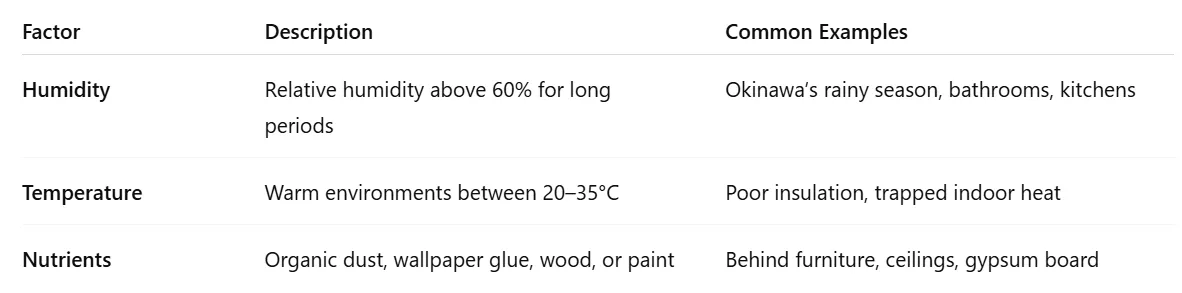
Even in modern houses, these three factors often coexist.
The key is moisture — wherever water enters or remains, mold follows.
1.2. How Construction Defects Invite Moisture into Hidden Spaces
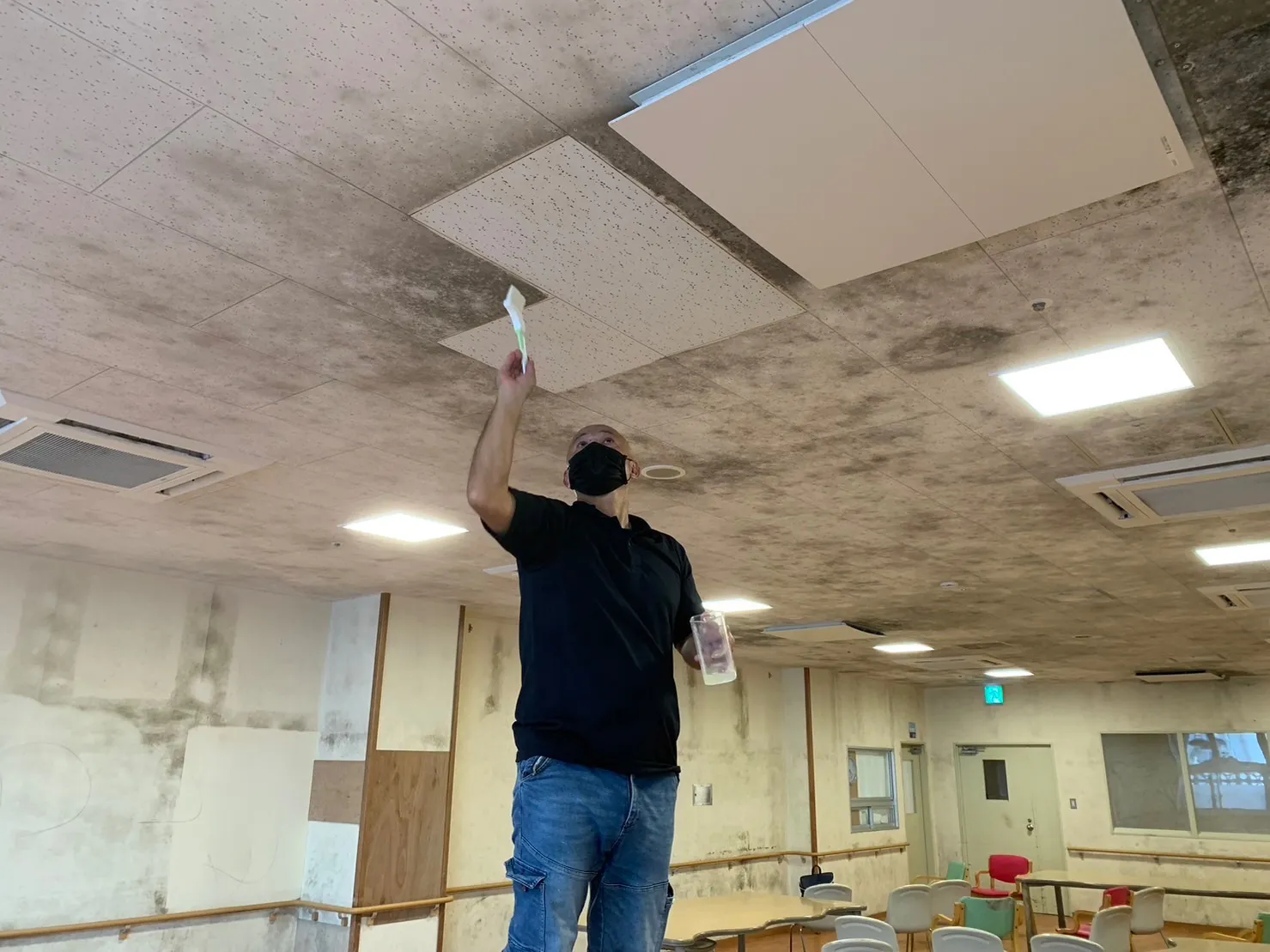
When a building has flaws in waterproofing, insulation, or ventilation design, moisture can sneak into walls, ceilings, or floors.
Common defect-related moisture pathways include:
Poor waterproofing on roofs or walls
Gaps or cracks around window frames (sash sealing failure)
Thermal bridging from missing insulation
Incorrectly executed foundation insulation (“airtight but damp”)
Insufficient airflow due to poorly designed ventilation systems
These invisible flaws allow moisture to stay trapped, feeding mold growth inside wall cavities or ceiling voids long before surface damage appears.
By the time dark stains become visible, mold colonies may already be widespread within the structure.
2. How Much of Mold Growth Is Caused by Structural Defects?
2.1. Research and Data Indicating a 20–60% Contribution from Building Defects
2.2. Structural Risks That Promote Mold: Hidden Wall, Ceiling, and Foundation Issues
2.1. Research and Data Indicating a 20–60% Contribution from Building Defects
According to international building health studies, between 20% and 60% of indoor mold problems are believed to have a direct link to construction or design defects.
For example, one study found that:
“Buildings with defective envelopes showed up to a 15-fold higher risk of mold growth.”
(Structural Home Defects Are the Leading Cause of Mold in Buildings, PMC 2022)
This doesn’t mean every flawed house will grow mold,
but it clearly shows that poor design and workmanship multiply the risk.
Here’s how different types of defects influence mold likelihood:
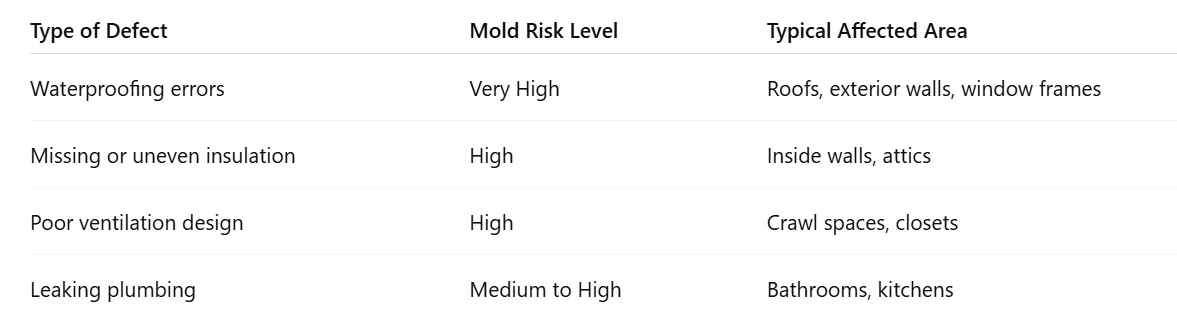
In short, even if you manage humidity carefully,
structural weaknesses can silently undo all your efforts.
2.2. Structural Risks That Promote Mold: Hidden Wall, Ceiling, and Foundation Issues
🧱 Inside Wall Mold
When insulation is missing or improperly installed, interior surfaces become cold spots.
Moisture condenses inside the wall cavity, allowing mold to thrive behind the wallpaper or gypsum board.
🌧 Ceiling and Roof Mold
Minor leaks through nails, seams, or flashing may not be visible from below,
yet even small amounts of moisture will raise the wood’s humidity enough to breed mold in the attic.
🪵 Foundation and Crawl Space Mold
In homes using underfloor insulation systems, airtight foundations can trap ground moisture.
If there’s no proper air circulation, concrete and insulation materials remain damp — a perfect mold incubator.
3. Beyond Construction Defects: The Role of Environment and Daily Habits
While construction flaws are major contributors,
mold problems are rarely caused by a single factor.
Living patterns, furniture layout, and Okinawa’s naturally humid climate often amplify the issue.
3.1. Lifestyle and Climate Conditions That Encourage Mold Growth
Frequent indoor laundry drying or excessive humidifier use
Not using kitchen or bathroom exhaust fans
Furniture placed flush against walls, preventing air circulation
Opening windows during humid weather (bringing in moist air)
The year-round high humidity typical of Okinawa’s subtropical climate
Each of these adds to the baseline moisture load inside your home.
When combined with even minor construction flaws, they can dramatically accelerate mold formation.
3.2. The Interaction Between Human Behavior and Building Flaws
The most severe mold problems usually appear when both sides are at play:
a structural weakness that allows moisture to enter, and daily habits that keep humidity high.
Therefore, prevention requires both lifestyle awareness and professional inspection.
4. What You Can Do to Prevent Mold Caused by Construction Defects
4.1. Homeowner Checklist: Signs of Possible Structural Issues
If any of the following situations sound familiar,
a structural defect may be contributing to your mold problem:
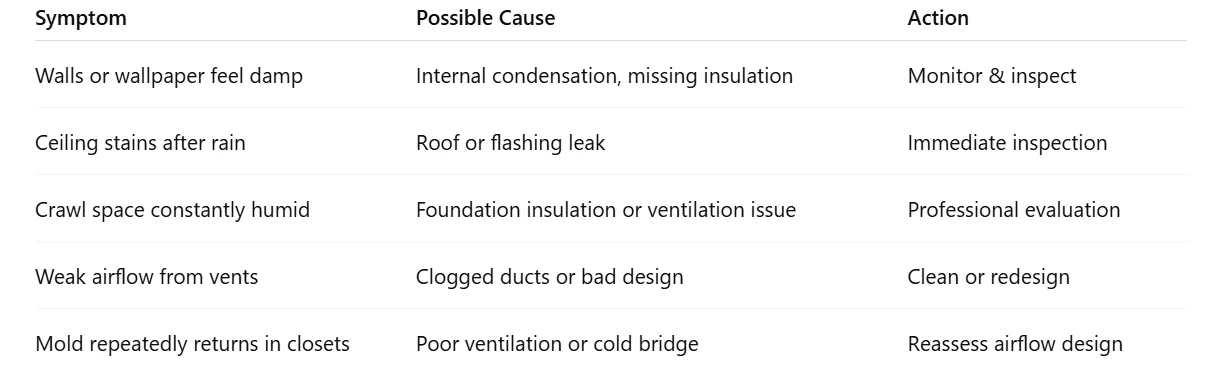
If surface cleaning doesn’t stop the mold from returning,
the root cause is likely within the structure itself.
4.2. Professional Inspection and the Mold Busters Okinawa Approach
Conventional bleach or alcohol-based cleaners can remove visible mold,
but they do not eliminate the spores rooted deep inside building materials.
That’s why Mold Busters Okinawa uses:
MIST® Method — a low-pressure mist decontamination system that penetrates materials safely
Third-party microbial testing (via the Japan Microbial Countermeasure Association)
Detailed investigation reports identifying structural and environmental causes
If the inspection confirms a building defect,
we can also coordinate with home inspection specialists and legal experts to support fair resolution with builders or property managers.
5. Conclusion: Construction Defects Matter — But They’re Not the Whole Story
Around 20–60% of indoor mold issues may involve some form of construction or design defect.
Such defects can multiply mold risk by up to 15 times.
However, environmental and lifestyle factors are equally influential.
In most homes, mold arises from a combination of structural flaws and everyday moisture behavior.
The most important takeaway is this:
Don’t assume mold means you “live badly.”
But don’t assume the builder is fully at fault either.
True prevention begins with an accurate, science-based diagnosis — identifying whether the cause lies in the building, the environment, or both.
6. From Mold Busters Okinawa
If you’ve experienced recurring mold even after cleaning or renovation,
there’s a good chance the cause lies beneath the surface.
Mold Busters Okinawa offers comprehensive, third-party-backed services:
Scientific inspection and moisture analysis
Safe internal mold removal with the MIST® method
Preventive maintenance and aftercare guidance
----------------------------------------------------------------------
カビバスターズ沖縄
沖縄県国頭郡金武町伊芸1996-13
電話番号 : 080-3977-9591
----------------------------------------------------------------------